

The Ontario Common Assessment of Need (OCAN) is the standardized assessment instrument used in the community mental health sector since 2009. This tool supports conversations between service providers and their clients. It helps to understand the client’s current situation better, needs and strengths, and to develop a service plan. OCAN assesses needs in 24 areas called “domains." OCAN supports a recovery approach with the inclusion of a client self-assessment component.
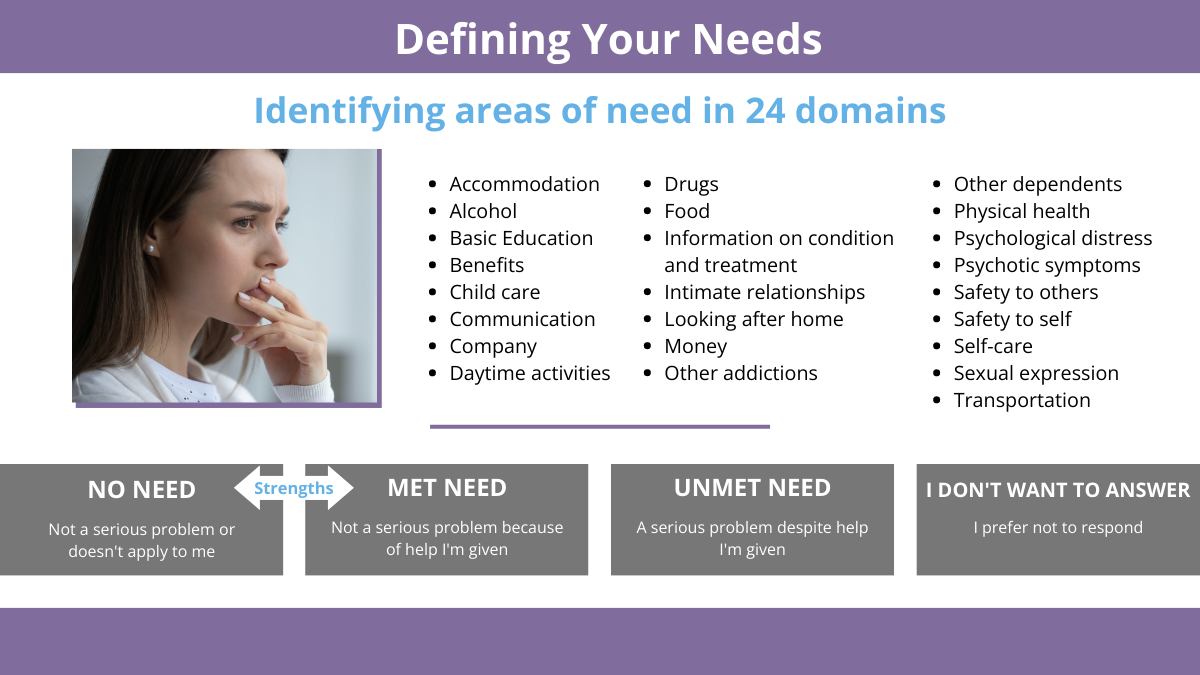
At a recent virtual train-the-trainer session hosted by EENet and Ontario Health, Rebecca Shaw, a short-term Case Manager at CMHA Peel Dufferin, discussed her organization’s approach to using the information collected in OCAN to support clinical care. Specifically, she shared how her team discusses the areas of OCAN where staff and clients have different perspectives on needs. She also shared their approach to goal planning with clients.
This edition of Experience Exchange features highlights from her presentation in her own words, edited for clarity and length.
How we use the OCAN as part of our recovery-based approach
At CMHA Peel Dufferin, we use the OCAN as part of a recovery-based approach, and this involves promoting the belief that each person has the potential for recovery. As an organization, we’re committed to a client-centred approach to care, using a strengths-based practice and working in partnership with our clients to help them enhance their independence. We also like to highlight the importance of client participation in their own care planning, so wherever possible we complete the OCAN with them to support that client-centred approach.
How we work with clients to develop their goals based on the OCAN information
Goal planning starts with an informal discussion about the client’s needs. Usually, people are good at identifying what they want to work on, what are the most important things in their lives that they need to improve.
We actively engage the client throughout the goal-planning process and we focus on how they can use their current strengths to work toward whatever goals we’ve identified. Not everyone is able to see what their own strengths are, so we’re there to help them do this. We usually prioritize basic needs they’ve identified as being unmet (e.g., food and accommodation), and then we start the work to meet those needs.
How we have conversations about different perspectives on needs
Example 1 offers some insights on how we would begin to facilitate a conversation when there is a difference between the client’s and the staff’s perspectives on an OCAN domain. In this case, the domain is “Daytime Activities” (employment, leisure and/or educational activities). The client rated this domain as “No Need” and the staff rated it as “Unmet Need”. In this example, the staff member highlights the link between the “Daytime Activities” domain and the “Psychological Distress” domain that the staff and client both identified as “Unmet Need”. Psychological distress is defined as symptoms of depression and anxiety. Clients sometimes struggle with defining what the issue is, in terms of the layering of those domains. By exploring this a bit further, the staff can get more information about the client’s view, which leads to better goal-planning outcomes.
Example 1
“I notice that you rated your daytime activities as no need (not a problem). I wonder if we can explore this a bit more. You often tell me you’re bored and feel depressed because you have nothing to do (psychological distress). Not engaging in activities you find enjoyable is affecting your mood. Can you tell me a bit more about this?” |
How we document goals
OCAN assessments are completed electronically. All the actions and goals documented in the assessment are automatically pulled into a chart at the end of the OCAN, called the “summary of actions.” We use the summary of actions in the OCAN to document the client’s goals. We share the information with our clients. This can be done in several ways:
- Print off the summary of actions for the client.
- Provide a copy of the entire OCAN to the client.
- Write the goals down on paper for the client.
The approach that we use for each individual will depend on that person’s ability to understand the information. For example, if there are literacy issues, it may not be helpful for them to have a summary of actions or a copy of the OCAN. For some clients, seeing all the goals on one page might feel really overwhelming. So, we need to work from where the client is and determine what would be helpful for them at that moment.
It’s also important to discuss the goals at each meeting so that we can follow up with the client about any progress they have made in achieving their identified goals or whether there are any other needs that might need to be addressed. Regularly reviewing those goals helps us to stay on track.
Client example
Example 2 describes a client who is precariously housed. Using the OCAN, we identified three domains of unmet need: “Accommodation,” “Physical Health” and “Psychological Distress.” Once we prioritized these domains, we identified goals for each one and we created a plan of action to help us determine what the client wanted to accomplish. For each of these, we identified actions that would help the client achieve these goals.
Example 2: Summary of actions
| Priority | Domain | Action(s) |
| 1 | Accommodation | Leave current living situation:
|
| 2 | Physical health | Get a family doctor:
|
| 3 | Psychological distress | Deal with feeling overwhelmed and depressed:
|
So we called for shelter space and completed a housing application. Once the client accessed the shelter, we began the application process for them to obtain the identification cards they needed to address their physical and psychological health goals. We worked with them to sign them up for Health Care Connect so they could find a family doctor.
Once we met their basic needs, the client identified the need to address their feelings of overwhelm and depression, so we signed them up for counselling sessions to learn coping strategies. Regularly reviewing those goals helps us to stay on track and focused on what has been prioritized by the client.