

On April 27, 2017, EENet presented a webinar as part of the Family Caregiver Community of Interest's Promising and Established Practices for Family Caregiver Engagement" series.
- learn about the Pyramid of Family Care as a framework to guide program delivery of family support;
- review the evidence on barriers and facilitators to supporting families of individuals with mental health problems and illnesses; and
- hear about how the Pyramid of Family Care was used as a framework for service planning, delivery and evaluation of family-centered services at CMHA Peel Dufferin.
Watch the webinar recording or view the presentation slides here.
The presenters
- Janet Durbin is an independent scientist at CAMH in the Provincial System Support Program, and an Associate Professor, University of Toronto
- Leanne Needham is a Registered Social Worker and is the Family Work Lead at CMHA Peel Dufferin.
Learn more about the Family Caregiver Community of Interest here.
Read the webinar summary below or download the summary PDF.
In brief
What is the Pyramid of Family Care?
The Pyramid of Family Care was developed in Australia to provide a framework for implementing integrated and coordinated care and support to family caregivers of individuals with mental health and addictions problems.
The pyramid is based on two ideas:
- If all family caregivers have their basic needs met, then only a small proportion will require more specialized services, and
- It is within the scope and competence of generalist mental health service providers to engage, assess, and address the basic needs of most family caregivers.
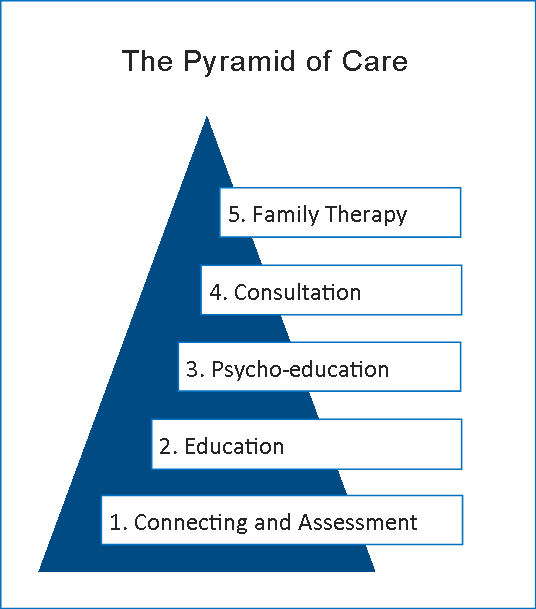
The Pyramid of Family care has five hierarchical levels of activities for meeting the support needs of family caregivers. The intensity of intervention increases as you move up the pyramid, while the number of family caregivers who are likely to require the intervention decreases.
The pyramid was proposed in the Mental Health Commission of Canada’s National Guidelines for a Comprehensive Service System to Support Family Caregivers of Adults with Mental Health Problems and Illnesses as a way to organize family support in line with their recommendations for improving access to support and education.
The tiered approach also supports flexibility in service delivery, which was flagged as important in a recent systematic review looking at barriers and facilitators to delivering family support.1
How can the pyramid be used in community-based mental health and addictions agencies?
Suggested uses of the pyramid of care include supporting the development of services, ongoing quality assurance and standardization of services, training of staff, and research and evaluation.
The Canadian Mental Health Association’s (CMHA) Peel Dufferin branch is using the pyramid of care to develop, guide, and evaluate family services program. Typically, front-line staff provide support based on levels 1 and 2 of the pyramid, and family workers have been offering support based on levels 3 through 5. They support on average 300 families per year.
Some examples of tasks related to each of the five levels include:
- Connecting and assessment: Introduce the mental health and family services that are offered and assess urgent and basic needs.
- Education: Understand family caregivers’ gaps in knowledge and appropriate ways to address these through education.
- Psycho-education: Provide a variety of supports to families (single family session or group session; online or in-person)
- Consultation: Look for appropriate referrals outside the organization, if required, that reflect family members’ needs.
- Family therapy: Provide counselling that focuses on family members’ needs, Including enhancing coping, problem solving, and communication skills, as well as specialized supports such as trauma informed care.
What are the key components of implementing the pyramid at CMHA Peel Dufferin?
At CMHA Peel Dufferin, the project’s staff identified the following key steps to ensuring the Pyramid of Care is successful:
- Educate management and staff about the pyramid of care and generate buy-in for providing family-centered care. This can be supported by the development of training modules for staff.
- Develop resources for families, such as welcome packages that include information about supports and services available within the organization and the community.
- Develop psycho-educational programs for families.
- Provide ongoing consultations with family support workers to front-line staff, to help them support families and know when to make a referral.
What is the evidence to support this program?
At CMHA Peel Dufferin, staff and families were surveyed about the types of interventions they received, their experiences with the Pyramid of Family Care, and other services or supports that would be beneficial to them. Early results show that the pyramid was implemented as it was intended. Family caregivers indicated that they found the following helpful:
- Skill building and information sharing;
- Help navigating the system;
- Advocacy in times of crisis; and
- Family meetings.
Evaluation is ongoing related to the implementation and outcomes for families.
What are the challenges to implementing this program?
Some of the challenges related to integrating the Pyramid of Family Care within the family services program at CMHA Peel Dufferin included:
- Providing ongoing training to new staff or when staff changed from one team to another within the organization;
- Booking time to support family caregivers as the organization shifted to family-centered care;
- Developing a better understanding of issues related to confidentiality; and
- Supporting a large geographical catchment area.
Next Steps
CMHA Peel Dufferin is now considering or planning several improvements to the program:
- Build on currently offered interventions, including offering an online psycho-educational program for families and a one-day workshop related to recovery;
- More training for staff, including specialized skills.
- Get more feedback from families, including through the use of the Ontario Perception of Care (OPOC) tool.
References
- Selick A, Durbin J, Vu N, O’Connor K, Volpe T, Lin E (2017). Barriers and facilitators to implementation family support and education in Early Psychosis Intervention programmes: A systematic review. Early Intervention in Psychiatry; 1-10. DOI: 10.1111/eip.12400
Additional Resources
Read the Mental Health Commission of Canada’s National Guidelines for a Comprehensive Service System to Support Family Caregivers of Adults with Mental Health Problems and Illnesses.
Read EENet's literature review about barriers and facilitators to family support in EPI programs.
Author: Alexandra Harrison